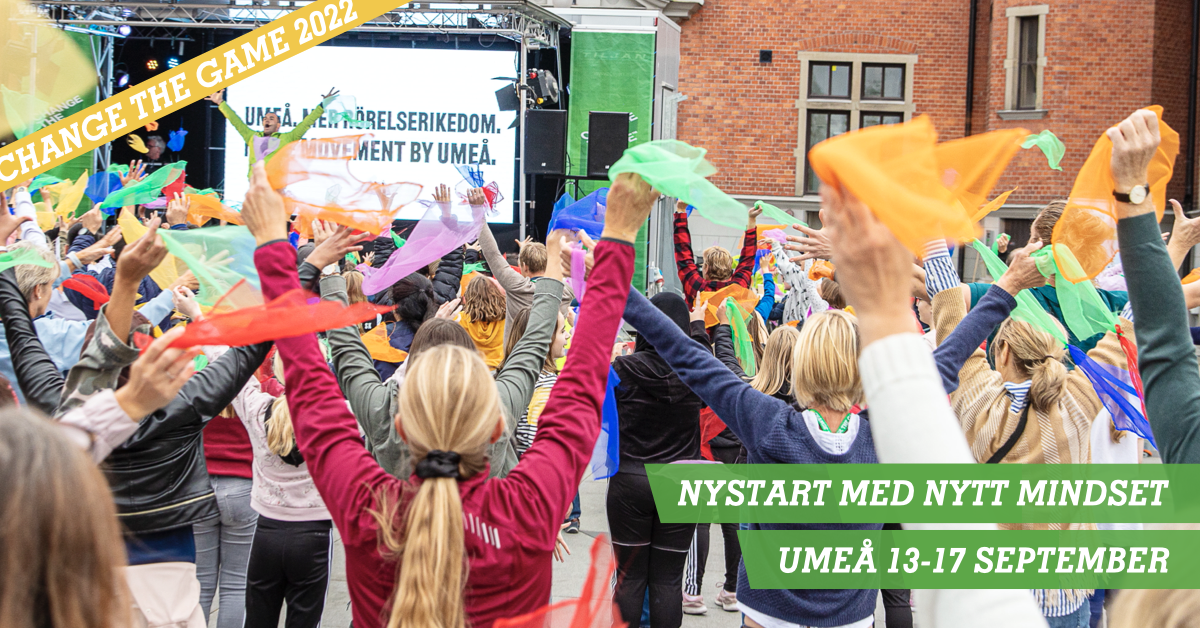
Movement that builds strong people – not just muscles.
More and more children and young people in Sweden are doing worse than they should. Stress, mental health issues and a lack of belief in the future have become recurring headlines. Change the Game wants to educate more people and help them see themselves as movement providers – in other words, to give them the ability to validate and develop movement activities that contribute to the holistic development of children and young people. Much good work is already being done today, but there is still a lot left to do – especially when it comes to connecting young people’s inner and outer capabilities.
For Change the Game, movement is not primarily about performance, burning calories or competition. It is about building sustainable human beings through a good relationship to movement.

“Movement experiences are important for children’s and young people’s development – not only from a physical perspective, but also to support psychological, social and creative potential,” says Tom Englén, Director of Change the Game.
“Movement experiences are important for children’s and young people’s development – not only from a physical perspective, but also to support psychological, social and creative potential,” says Tom Englén, Director of Change the Game.
The organisation works from the concept of Physical Literacy and, above all, from a holistic view of the human being in motion – considering both the outer and inner dimensions. Together with Swedish and international partners, they want to raise the quality of how movement is used in schools, sport and other environments for children and young people. Some of their recent collaborations include the Research Center for Human Potential in Montreal and partners within the network “Inner Development Goals for children and young people in Sweden.”
A low-hanging fruit in school
Tom Englén believes that schools hold a huge, untapped opportunity.
“We clearly see a need for integrated learning. Students need to be able to move while learning traditional subjects and developing their self-leadership. There are still very few good examples of this, even though it could be a low-hanging fruit. By strengthening teachers’ and school leaders’ willingness and ability to work in this way, we can quite quickly make school both more meaningful and more effective.”
The same approach applies within sport. Children’s and youth sport can do a great deal of good, but the quality of activities is crucial to the impact they have.
“Sports coaches have an enormous opportunity to develop children both as athletes and as people. It’s not about choosing one or the other – it’s about combining them,” says Tom Englén.
When quality beats quantity
Sometimes the quality and the abilities are already there – without being recognised.
“In preschool, we sometimes see natural excursions being replaced by something like the equivalent of an adult gym session – surely with the best intentions. But we know that a walk to a small forest area can challenge children in many different ways at the same time, which that ‘PE class’ is probably nowhere near,” says Tom Englén
The relational crisis
Change the Game draws on sustainability research that points to a relational crisis in society.
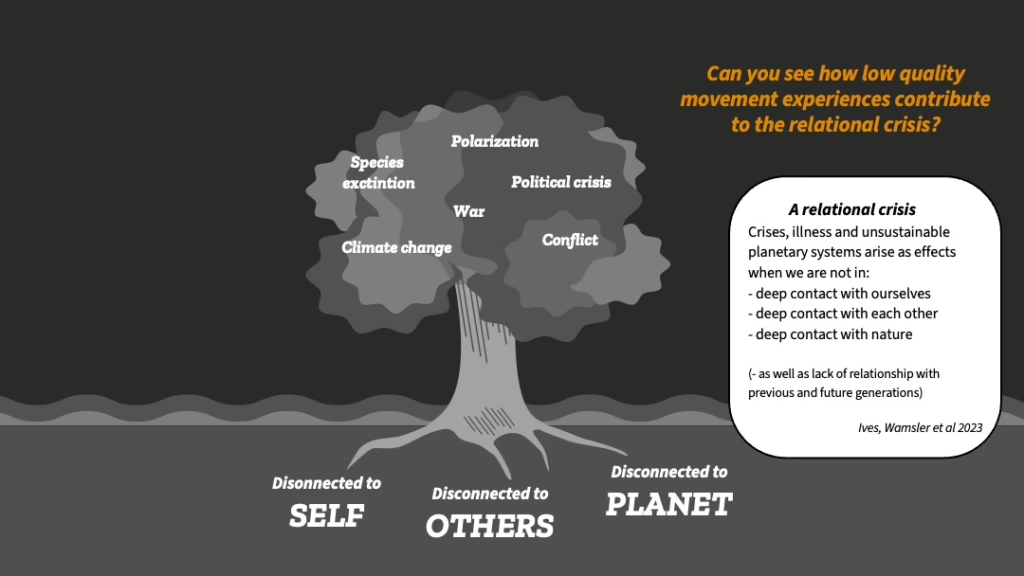
“We are losing more and more contact with ourselves, with each other, and with our place in the world. That also makes us ask what role physical activity plays in strengthening or counteracting that development. We often say that children and young people should move more and make better choices – that they should pull themselves together. But they make their choices based on the conditions we give them. That’s why we, the adult world, all together, need to become better at creating environments that make it easy to choose right.”
Change the Game draws on sustainability research that points to a relational crisis in society.
“We are losing more and more contact with ourselves, with each other, and with our place in the world. That also makes us ask what role physical activity plays in strengthening or counteracting that development. We often say that children and young people should move more and make better choices – that they should pull themselves together. But they make their choices based on the conditions we give them. That’s why we, the adult world, all together, need to become better at creating environments that make it easy to choose right.”

“It’s not about chasing symptoms – it’s about working in a long-term, preventive and health-promoting way. If we want children and young people to feel well, we need to build systems that help them flourish, not just survive. That’s where we at Change the Game want to contribute – and can contribute.”

A new development programme
During 2026, Change the Game will work together with local and regional stakeholders to run a new development programme for leaders who create movement experiences that support children’s and young people’s inner development and wellbeing.
It is called “Shine as they should” and will offer a few teams of movement enablers support to explore new ways of running activities that can strengthen children’s and young people’s inner development and wellbeing. The programme will show the way for how we can integrate movement, self-leadership and learning in areas such as school, healthcare and community organisations.
Together, an exploratory journey will be carried out to strengthen the teams’ own organisations and contribute to more people strengthening their willingness and ability to co-create a future where all children and young people get the chance to become their best selves. The programme will include at least four teams, run between April and October, and will be launched within the next couple of weeks.
The annual event 2026
Change the Game 2026 will be held in Umeå at the end of September.
Theme of the year: Movement that matters
We focus on how movement can help children and young people develop and thrive in a fast-paced and complex world. We need to strengthen their inner abilities so that they can cope better. Movement, both in school and in leisure time, can make a major difference. This requires us to become better at intentionally creating experiences that are fun, meaningful and valuable.
England leads the way towards a moving world
In September 2023, the “Physical Literacy Consensus Statement for England” was released, a document that aims to create a shared understanding of the concept of Physical Literacy and its role in health, education and sport. The document is the result of a process involving researchers, practitioners and policy makers from a wide range of sectors – from schools and public health to sport and leisure. Now, early adopters have very promisingly begun to use it as an innovation tool to create movement experiences that make a difference.

– We wanted to do and think differently to get children and young people moving more, so we started a process to create a consensus statement. We want to create a common language and consensus for movement where we can talk to stakeholders across sectors, which is crucial to being able to create positive movement for people of all ages, explained Charlie Crane, project manager at Sport England, when she appeared on our podcast The Movement Revolution earlier this year.
According to the consensus statement, Physical Literacy is “our relationship to movement and physical activity throughout life”. It is not just about what we do, but how we think, feel and connect with people and the environment when we move. This relationship is influenced by the quality of our movement experiences, which in turn is determined by the ability and willingness of movement providers to value and design the places, activities and programs we participate in.

“Hopeful and inspiring”
– We are increasingly losing touch with ourselves, each other and with nature. Fun, meaningful and valuable movement experiences help strengthen these relationships and therefore it is super important that we movement providers develop our leadership in that direction. It is so hopeful and inspiring to see how so many major players in England, with the help of Physical Literacy, are developing the ability to create and value qualitative movement experiences, says Tom Englén, director, Change the game.
Why was a common framework needed?
The term Physical Literacy is used internationally in an increasing number of countries, but with slightly different definitions. In England, there was a perceived need for a unified understanding that could guide strategies and interventions. The consensus statement is intended to serve as a basis for everyone who works to create activities and environments that develop both people’s physical and inner abilities – from teachers and coaches to policy makers.
Some key messages in the statement:
- Understand Physical Literacy – it is a lifelong process, not a skill you “achieve”. Can be both a method and a state.
- Why it is important – physical activity is not automatically good, but positive movement experiences can promote both health, well-being and performance.
- How our relationship with movement can be supported – by creating meaningful, valuable and fun experiences.
- A holistic view of the person – who does, feels, thinks and connects when we move.
An important step towards the vision
The long-term strategy for Sport England “Uniting the Movement” emphasises that all children and young people have the right to positive experiences of physical activity. The consensus statement is a first step towards putting this vision into practice. Charlie Crane, project manager at Sport England, highlights that the document will help sport create inclusive environments where people can develop a sustainable relationship with movement.
Next steps in England
Work is now underway in England to implement Physical Literacy in practice. This means that coaches, teachers and organisations need to adapt their efforts based on individuals’ motivation, needs and life situation. The aim is to reduce inequalities and promote lifelong participation – not just in sport, but in all forms of physical activity. All of this work is now being done under the name “Positive experience collective”.
They have now gathered actors, the earliest adopters, in two rounds to take part in a development programme called the “Patchwork programme”.
Actors have been divided into constellations according to their field of activity. At regular intervals, they share their experiences in “Listening circles” and in an “Annual gathering”. These events are often online and are open to everyone to participate in and can be viewed afterwards.

– It is very inspiring to see how movement enablers, thanks to their consensus work, strengthen their ability to create movement experiences, not least the ability to listen to children and young people to obtain a more valuable basis for the design of physical environments, says Grim Jernudd, trainer and method developer, Change the game.
Are you curious to know more about this exciting journey taking place in England, check out:
PL consensus statement in England >
Positive experience collective >
You are also welcome to contact us at Change the Game to get more info about physical literacy, about how it is applied in England and other parts of the world.
Change the game was admitted as full members of the International Sports and Culture Association
At ISCA’s 2025 General Assembly held in Copenhagen, Denmark, on Saturday, November 1, Change the game was admitted as a full member.
”The International Sport and Culture Association is a non-governmental and not-for-profit umbrella association open to organisations working within the field of recreational sport and physical activity. Its 260 members span across five continents and the network is ever expanding.”
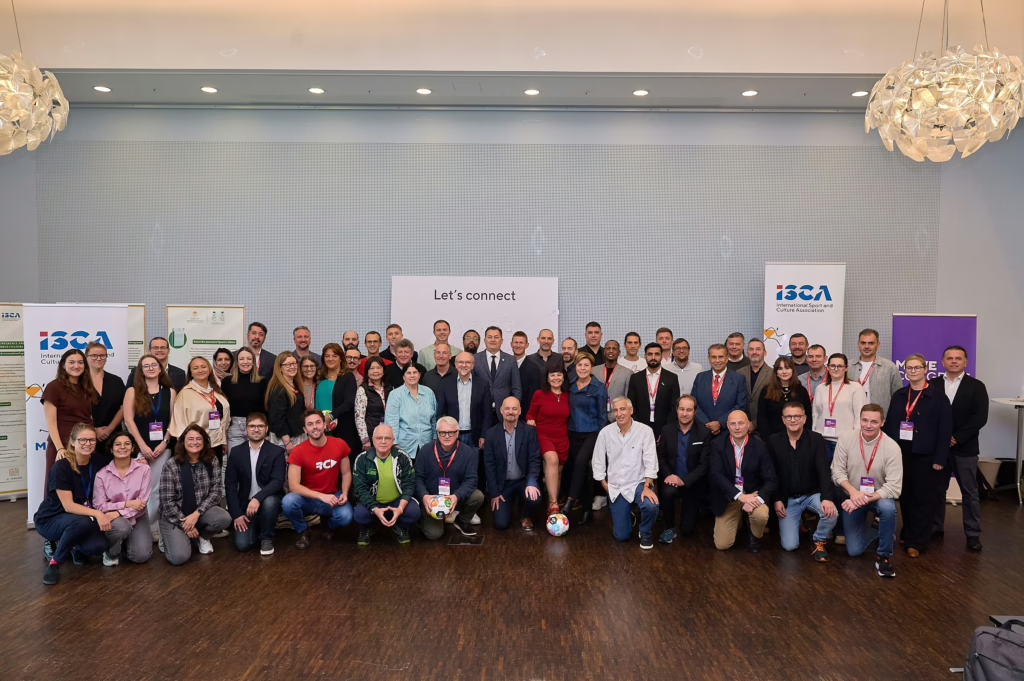
Delegates at the ISCA General Assembly – Copenhagen 1 November 2025
This year marks ISCA’s 30th anniversary. ISCA was founded on February 10, 1995 in Copenhagen. This anniversary was celebrated with the MOVE Congress on October 29-31, which attracted 900 participants representing more than 200 different organizations from 60 different countries.

– Becoming a “full member” of ISCA is an exciting step in the development of Change the games collaboration internationally to be able to contribute even more to active societies here at home, says operations manager Tom Englen, who participated on site during the general assembly and congress.
Change the game 2023
Change the game’s annual activity and training days in September focus on physical literacy. The event offered the opportunity to test new activities and the opportunity to develop leadership skills for everyone who wants to create environments where everyone gets a good chance for an active, healthy life and to have their best life journey.
September 11-17th in Umeå
Theme: “Frontrunners in movement”
The pandemic has clarified the need for us to take a new approach to increase participation in physical activities. In some activities, such as children’s and youth sports, participation has decreased extra much over the past two years. This is one of several pressing challenges that concern the importance of creating new sustainable solutions for developing attractive environments where people can flourish. Therefore, we will focus on how we with physical literacy as a compass can develop leaders’ ability and motivation to create even better activities and environmental offerings that encourage active participation.
Summary Change the game 2022 (pdf) >
Insights & tips with keynote speaker (videos) >
Content:
:: Conference with the opportunity to participate both physically and digitally
:: Workshops for different target groups
:: Activities to test for different interests and abilities
Program overview (220621)
As usual we will have participation’s of leading international and national researchers and practitioners together with local pioneers.
Sessions with international speakers will be held in english and the other sessions in swedish.
More information about the program will be released ahead.
If you have any questions, please contact us via email: info@change-the-game.se
Organizers
Change the game together with, among others, Balticgruppen, Sport school of science at Umeå university, Västerbotten Region (Regional health and development department), RISE, RF-SISU Västerbotten (Regional Sport confederation) and Umeå Municipality.