Movement that builds strong people – not just muscles.
More and more children and young people in Sweden are doing worse than they should. Stress, mental health issues and a lack of belief in the future have become recurring headlines. Change the Game wants to educate more people and help them see themselves as movement providers – in other words, to give them the ability to validate and develop movement activities that contribute to the holistic development of children and young people. Much good work is already being done today, but there is still a lot left to do – especially when it comes to connecting young people’s inner and outer capabilities.
For Change the Game, movement is not primarily about performance, burning calories or competition. It is about building sustainable human beings through a good relationship to movement.

“Movement experiences are important for children’s and young people’s development – not only from a physical perspective, but also to support psychological, social and creative potential,” says Tom Englén, Director of Change the Game.
“Movement experiences are important for children’s and young people’s development – not only from a physical perspective, but also to support psychological, social and creative potential,” says Tom Englén, Director of Change the Game.
The organisation works from the concept of Physical Literacy and, above all, from a holistic view of the human being in motion – considering both the outer and inner dimensions. Together with Swedish and international partners, they want to raise the quality of how movement is used in schools, sport and other environments for children and young people. Some of their recent collaborations include the Research Center for Human Potential in Montreal and partners within the network “Inner Development Goals for children and young people in Sweden.”
A low-hanging fruit in school
Tom Englén believes that schools hold a huge, untapped opportunity.
“We clearly see a need for integrated learning. Students need to be able to move while learning traditional subjects and developing their self-leadership. There are still very few good examples of this, even though it could be a low-hanging fruit. By strengthening teachers’ and school leaders’ willingness and ability to work in this way, we can quite quickly make school both more meaningful and more effective.”
The same approach applies within sport. Children’s and youth sport can do a great deal of good, but the quality of activities is crucial to the impact they have.
“Sports coaches have an enormous opportunity to develop children both as athletes and as people. It’s not about choosing one or the other – it’s about combining them,” says Tom Englén.
When quality beats quantity
Sometimes the quality and the abilities are already there – without being recognised.
“In preschool, we sometimes see natural excursions being replaced by something like the equivalent of an adult gym session – surely with the best intentions. But we know that a walk to a small forest area can challenge children in many different ways at the same time, which that ‘PE class’ is probably nowhere near,” says Tom Englén
The relational crisis
Change the Game draws on sustainability research that points to a relational crisis in society.
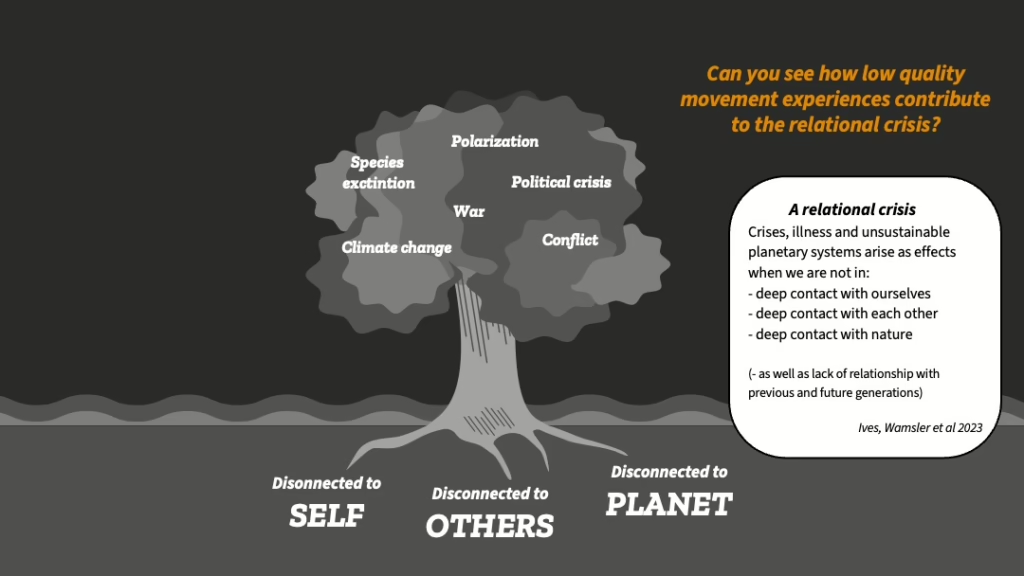
“We are losing more and more contact with ourselves, with each other, and with our place in the world. That also makes us ask what role physical activity plays in strengthening or counteracting that development. We often say that children and young people should move more and make better choices – that they should pull themselves together. But they make their choices based on the conditions we give them. That’s why we, the adult world, all together, need to become better at creating environments that make it easy to choose right.”
Change the Game draws on sustainability research that points to a relational crisis in society.
“We are losing more and more contact with ourselves, with each other, and with our place in the world. That also makes us ask what role physical activity plays in strengthening or counteracting that development. We often say that children and young people should move more and make better choices – that they should pull themselves together. But they make their choices based on the conditions we give them. That’s why we, the adult world, all together, need to become better at creating environments that make it easy to choose right.”

“It’s not about chasing symptoms – it’s about working in a long-term, preventive and health-promoting way. If we want children and young people to feel well, we need to build systems that help them flourish, not just survive. That’s where we at Change the Game want to contribute – and can contribute.”

A new development programme
During 2026, Change the Game will work together with local and regional stakeholders to run a new development programme for leaders who create movement experiences that support children’s and young people’s inner development and wellbeing.
It is called “Shine as they should” and will offer a few teams of movement enablers support to explore new ways of running activities that can strengthen children’s and young people’s inner development and wellbeing. The programme will show the way for how we can integrate movement, self-leadership and learning in areas such as school, healthcare and community organisations.
Together, an exploratory journey will be carried out to strengthen the teams’ own organisations and contribute to more people strengthening their willingness and ability to co-create a future where all children and young people get the chance to become their best selves. The programme will include at least four teams, run between April and October, and will be launched within the next couple of weeks.
The annual event 2026
Change the Game 2026 will be held in Umeå at the end of September.
Theme of the year: Movement that matters
We focus on how movement can help children and young people develop and thrive in a fast-paced and complex world. We need to strengthen their inner abilities so that they can cope better. Movement, both in school and in leisure time, can make a major difference. This requires us to become better at intentionally creating experiences that are fun, meaningful and valuable.

